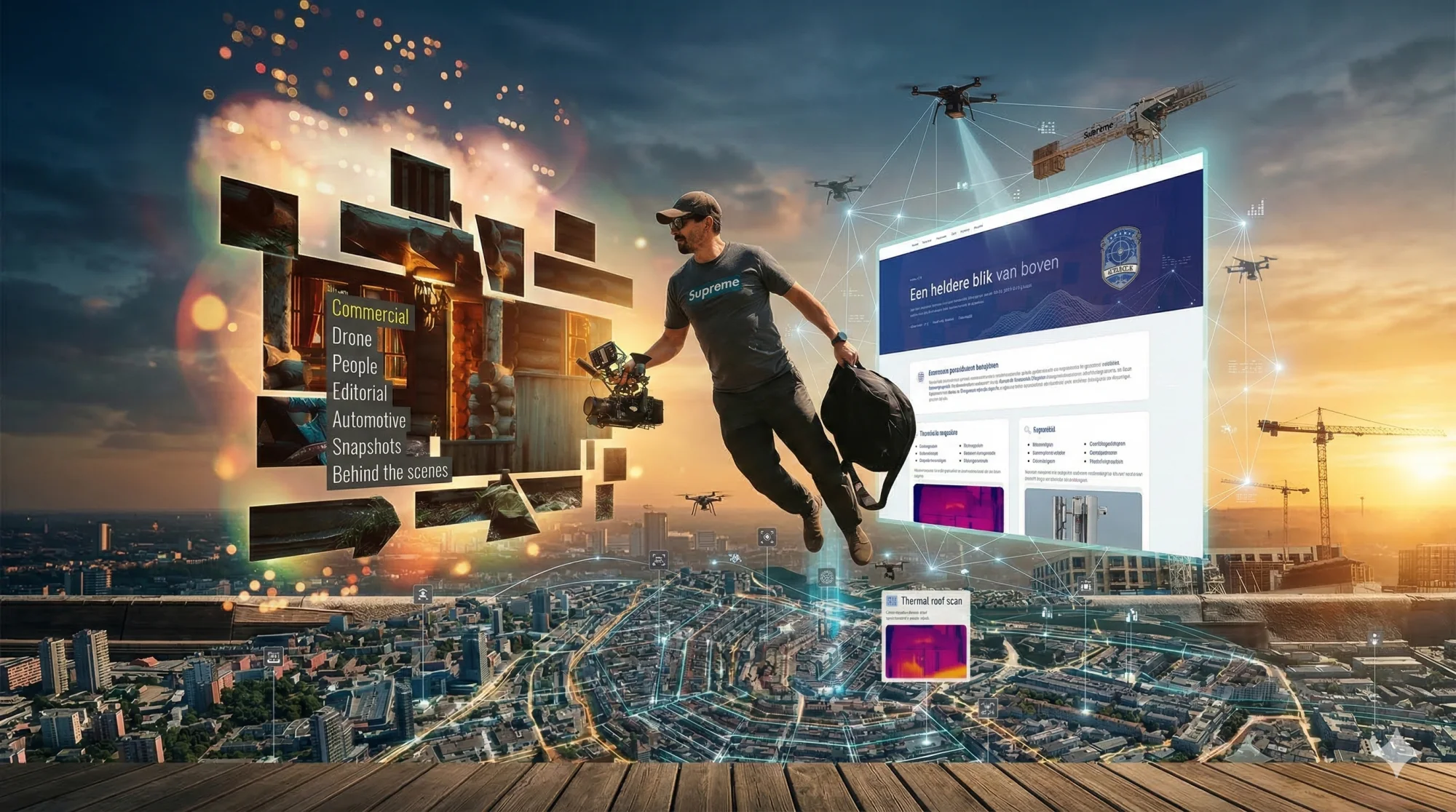
The impact of AI on my work is everywhere today. I notice it in client meetings, in briefings, and simply in what appears online. Image creation has suddenly become accessible to everyone. With just a few lines of text, you can generate photos, illustrations, or videos that look impressive.
For someone who has spent 20 years working professionally with images, that feels strange. Yet, I don’t see this as the end of my work; it’s just the end of an era.
We’ve seen this before. We saw it when the industry shifted from analog to digital photography, it didn’t kill the game, it just changed the rules. We saw it again with the rise of stock photography, when suddenly you could buy an image for a few euros that was "good enough." Each time, the industry was shaken, but ultimately, the demand simply changed. As a creator, you had to prove why your custom work was more relevant, more authentic, and more meaningful than a generic shot from a database. We are at that same point today. The question is no longer whether I can create something, but whether I can create something that is substantively and creatively stronger or cheaper than what an algorithm spits out.
That is the new reality, and I’m not bitter about it. Technology evolves, and you have to move with it.
The dance between creativity & technology
That is why, alongside my creative work, I have deliberately built a second path: AirScout (www.airscout.be). While my other work focuses on storytelling and emotion, AirScout is about precision and data.
Using drones, I perform technical inspections and create 3D mappings of buildings, infrastructure, and landscapes. This goes far beyond just “a nice drone photo.” It’s about photogrammetry: converting hundreds of aerial photos into highly accurate 3D models or point clouds that are precise to the centimeter. This is work where reality is the only thing that matters. An AI can invent a beautiful factory, but it cannot inspect the exact condition of your specific roof or generate an accurate elevation model of a site. You have to physically be there to extract that data from the real world.
Looking in the Mirror
There is, of course, a double-edged sword at play here. I use AI extensively to build tools that speed up my own workflow—tools that automate tasks that used to require a copywriter, a translator, or even a programmer.
I am an active participant in the same evolution currently hitting my own sector. If I use technology to make my business more efficient, even if it replaces work traditionally done by others, it would be hypocritical to take the changes in the visual world personally. It’s not an attack on my craftsmanship; it’s a technological shift happening everywhere at once. I see it as a challenge to redefine my own relevance.
The core remains outdoors
Despite all these digital aids, I’ve set one clear boundary for myself: I want to work outside. That has always been the core of why I enjoy this. I never became a “Photoshop artist” spending days behind a screen manipulating images. True satisfaction comes from the fieldwork form. Observing, working with people or be in various environments, finding the right light and the right angle. Whether I’m capturing a cinematic shot for a film or a complex 3D scan for a technical report, the action happens outdoors.
People often want to put me in a box: i’m or a photographer, or a director, or a drone pilot. But never all of them. That has been my career-long battle. But those labels never cover the full picture. AirScout isn’t a break from my past; it’s an extra layer. One moment I’m focused on story and emotion, the next on hard data and insight.
As long as I can use cameras and drones to capture the world, whether through directing, photography or a technical flight: then I’m exactly where I want to be. AI is changing the industry, but the combination of curiosity, technical expertise, and a willingness to get my boots dirty remains my most important asset.
See you there: www.nikocaignie.be & www.airscout.be