Not every shoot needs a cinema rig, a full crew, and a van full of gear. Sometimes, the best tool for the job is the one that lets you move fast, adapt quickly, and get the job done without overcomplicating things.
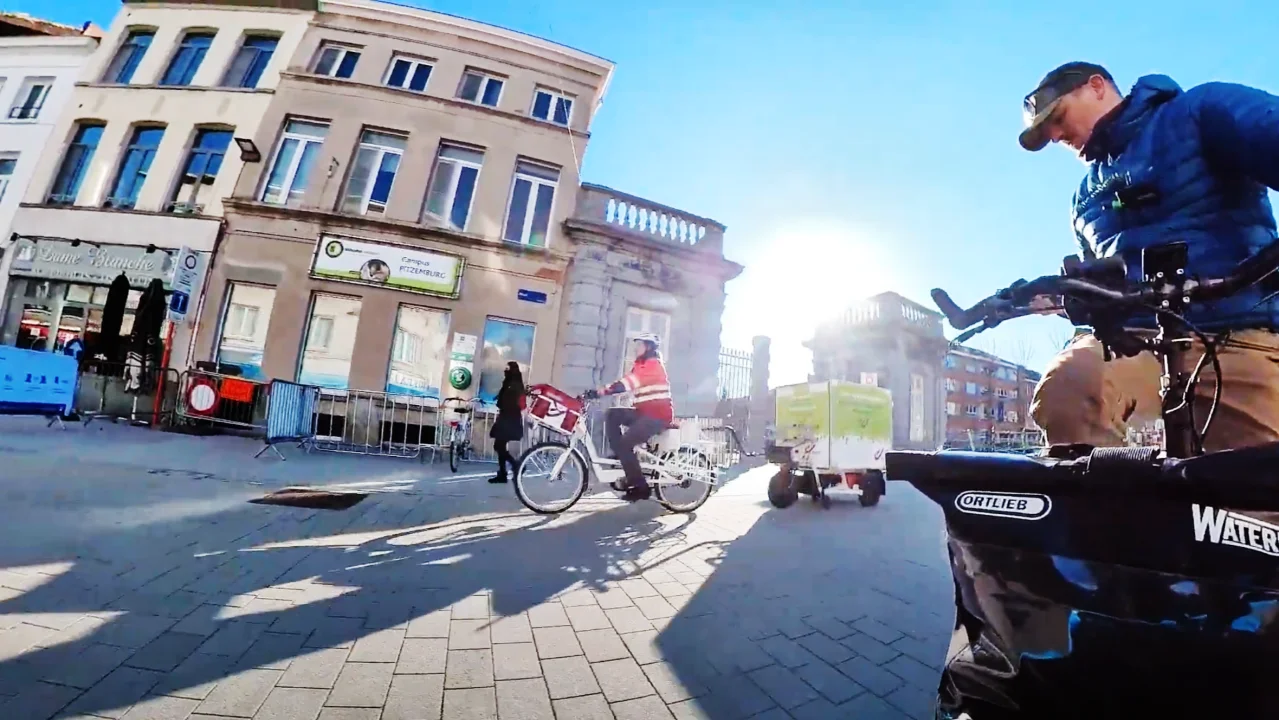
For a micro-campaign with Stad Mechelen and bpost, the goal was clear: follow an eco-delivery guy on his bike route through the city, easy peasy. But there were some challenges:
A car wasn’t an option, too slow, too bulky, and completely impractical for weaving through Mechelen’s streets.
A long shot list, far more locations and angles than you’d ideally squeeze into a single day with a normal video project approach.
A one-day shoot budget and availability didn’t allow for a second day.
That meant agility was everything. There was no time to set up tripods, rig stabilizers, or wait for perfect conditions. I needed to capture dynamic shots on the go, react quickly to opportunities, and cover a lot of ground, all without slowing down the subject who was actually working his shift.
So I grabbed a DJI Osmo Pocket (V2 at that time) and loaded up my Bullitt cargo bike.
Why? Because speed and flexibility were more important than having the biggest, most cinematic setup.
Lots of moving shots? Built-in gimbal = smooth footage.
Tracking a cyclist through the city? My Bullitt cargo bike made it happen.
Fast, efficient shooting? No time wasted setting up heavy gear.
The reality of a one-day agile shoot
With an extended shot list and just one day to shoot, there was almost zero room for do-overs. Every shot had to be planned and executed efficiently while still allowing space for spontaneous moments that would make the video feel alive. It was all about quick thinking, fast adjustments, and trusting my instincts.
Physically, it was also a challenge. Filming while cycling is a whole different skill, balancing, framing the shot, and staying aware of traffic, all at the same time. No director’s chair, no controlled set, just real-world action unfolding in front of me. After a full day of riding through the city with my gear, let’s just say… I felt it in my legs the next day!
Would I do it differently today? Absolutely.
This was four years ago, and looking back, I’d definitely tweak a few things. With newer tech and refined workflows, my approach has evolved as well.
Could I have done all this with bigger, better gear? Yes!
Would that have slowed us down and made the shoot impossible within a day? Absolutely!
There were choices to be made, and for the budget, timing, and project scope, we went with the right tool for the job.
High-speed decision-making
Unpredictable real-world shooting
Pushing the limits of what’s possible with minimal gear
That’s what I love about this job, it’s never just about having the best equipment, it’s about knowing what the project needs and adapting accordingly.
And even after all this time, I still look back at this micro-campaign with pride. It were the right tools for the right budget, and that’s what made it work.
I firmly believe that every project deserves the right tool for the right job, not just the biggest or most expensive setup. It’s about understanding the needs of the shoot and adapting accordingly, whether that means using a high-end cinema rig or, in this case, a pocket-sized camera and a cargo bike.
I even wrote an entire article about this mindset and how avoiding the gear rabbit hole can actually make you a better creative. If you’re curious, check it out here: Growing by Dodging Rabbit Holes
The most extreme “right tool for the right job” I’ve ever done
I’ve applied the right tool for the right job philosophy to many projects, but this one? This was the most extreme case yet.
Filming a fast-paced delivery route, solo, in a single day, with a DJI Osmo Pocket 2 and a cargo bike, that’s about as stripped-down as it gets. No heavy rigs, no big crew, just pure efficiency and adaptability. And yet, it worked.
Would I normally approach a campaign shoot like this? Probably not. But given the constraints, it was the best solution for the job, and honestly? I’m still incredibly proud of it. It proved that creativity and adaptability matter more than gear, and that sometimes, the simplest setups can deliver the best results.
Just to be clear, I’m not suggesting that every campaign should be shot with a DJI Osmo Pocket 2. That’s not the point. The real takeaway here is that creativity isn’t just about scripts, framing, or storytelling—it also applies to gear choices.
Too often, we think of creativity only in terms of concepts and visuals, but being smart about how you execute an idea with the tools available is just as important. You don’t always need the biggest, most expensive setup to get the job done. Sometimes, being resourceful and agile is what makes the difference between a shoot that works and one that gets stuck in logistics.
At the end of the day, it’s not about what you shoot with, it’s about how well you execute the idea within the given boundaries. And a happy client!
Here's the final result: