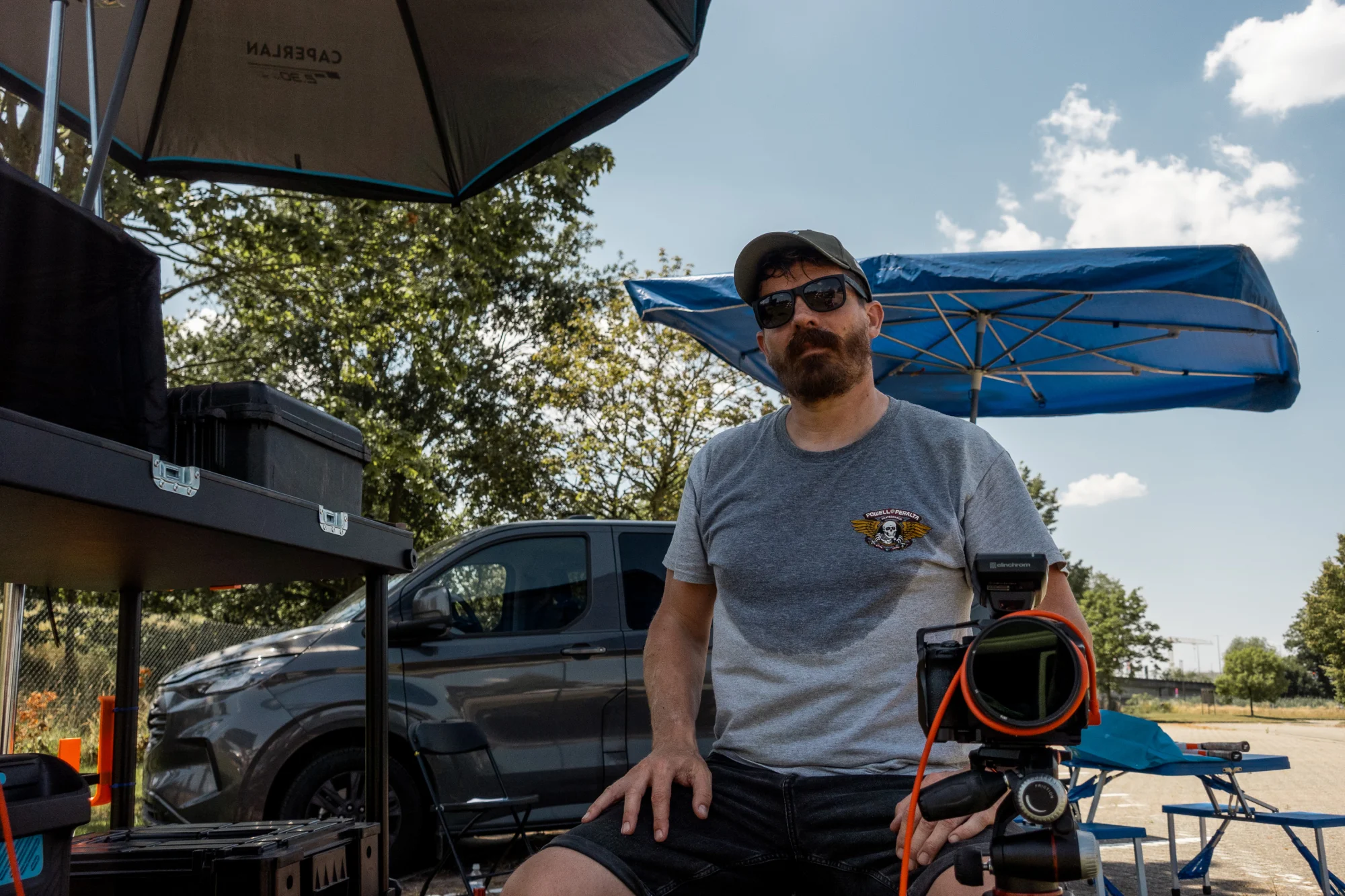
Two full days. Outdoors. In direct sunlight. Under what the Belgian weather institute politely calls “code orange.”
Temperature: 38°C.
Schedule: 11 hours.
Days: 2
Location: nothing but concrete, dust, glare, zero shade — and plenty of sweat.
But this time… we came prepared.
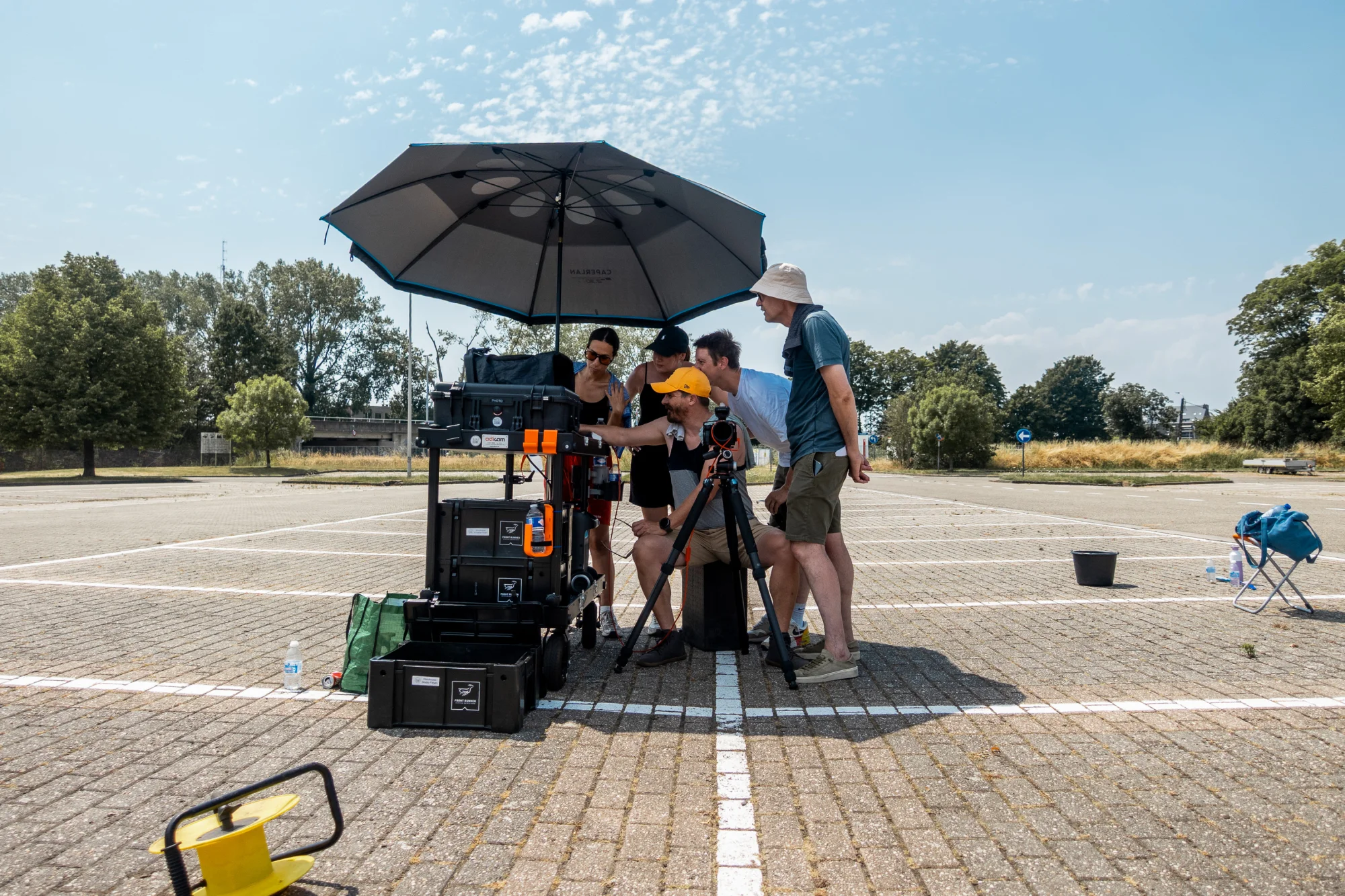
We brought cooling towels, scheduled regular breaks, created shade wherever we could. We literally walked around with wet towels on our heads like we were shooting a desert expedition. And guess what? It worked. The day was tough, but manageable. Nobody collapsed. Everyone stayed focused — or at least somewhere in the vicinity 😉
We took care of each other and ourselves, which meant we could stay sharp and creative, even in those blazing-hot conditions. And it got me thinking…
Because it hasn’t always been that way.
There was a time I didn’t see myself as a priority.
When I believed being “professional” meant ignoring your own needs.
Just push through. All the way. The client is here.
The crew is watching. You have to be strong. You have to set the example.
Turns out, that’s complete nonsense.
And I learned that lesson the hard way. Multiple times.
The speedboat shoot:
Standing on a speeding boat flying over the waves, cam in hand, wind hammering into me, no harness, no safety cable, one hand on the camera, one hand trying to hold myself upright. “It’ll be fine, right?”
It didn’t go wrong — but it could have.
I got smarter (and safer) after that. But honestly, the fact I made it through those early years without a single major accident is a miracle.
The helicopter job:
No ear protection, no flight briefing, no harness. Just a headset slapped on, the door slid open, camera and stabilizer hanging out while I prayed the seatbelt would hold. I didn’t even think about air pressure, balance, or what happens if you slip at 200 meters altitude.
Professional? Not even close.
The car shoot:
Half hanging out of a moving car on a highway. No harness, no spotter — just me, a camera in hand, shouting at the other car to “go faster!”
Looking back?
That’s not brave.
That’s just dumb.
I was lucky. No accidents. No lasting damage. But I did pay a price — mentally.
Because even if the body holds up, your mind takes the hit.
And the worst part? If anything had gone seriously wrong — it would’ve been on me. Because I allowed it.
I know better now.
My body is my toolbox and think tank.
As my dad always said: “You’ve only got one body. And it’s not a machine you can swap parts on.”
So now, I don’t start any shoot without that mindset.
I take care of myself — physically, mentally, emotionally.
And I expect the same from those around me.
Safety, respect, humane working conditions — these aren’t “nice to haves.” They’re baseline.
I surround myself with crew and assistants who live by the same values — people who look out for themselves and for me.
That’s non-negotiable.
If it’s 38 degrees? You adjust.
If you’re on a boat? You wear a harness.
In a helicopter? You protect your ears and you clip in.
And if something doesn’t feel safe?
You press pause. Period.
And it’s not just about physical safety either: Mental health matters just as much.
The pressure to always deliver. Taking on too many jobs.
Running from project to project with no breathing space.
It takes its toll. Not today. Maybe not tomorrow.
But long term? Hello, stress symptoms. Hello, burnout.
Been there too.
Shoots where I was still standing physically — but mentally completely wiped out. No creativity left, no sharpness, just survival mode.
That’s not working. That’s not living.
So now, I choose differently. I build in breathing space.
I say no more often. I choose quality over quantity.
Not just for my clients. But for myself.
Because when I’m doing well — in body and mind — I do better work.
Simple as that.
The break that never comes
Here’s the thing: on set, everyone gets a break.
Models step aside to rest or switched
Assistants grab some shade.
The stylist checks their phone.
The agency takes five.
The clients goes for a coffee
...
And me? No break.
I’m switching from photo to video to drone, checking the last images, talking to the client, discussing with the agency, giving direction to the models, answering crew questions. When one task pauses, another starts. There’s no “off switch.”
Those days are intense. Not just physically — but mentally and emotionally. It’s like running three marathons at once, while also being the coach and the referee. And when you string multiple days like that together, the impact is brutal.
That’s why recovery isn’t optional. It’s necessary. Because if I don’t step back and recharge after those days, the next project will pay the price.
The sleep trap
If there’s one thing I underestimated for years, it’s sleep.
When you’re juggling multiple projects, back-to-back shoots, deadlines, and travel, it’s so tempting to shave hours off the night.
“Sleep later. Push through. Coffee will fix it.”
And for a while… it works. You run on adrenaline, and it even feels good — sharp, buzzing, like you’re unstoppable.
But here’s the catch: adrenaline is only good for a very short while. It’s not fuel, it’s a credit card. And the bill always comes due.
Because the truth is, sleep debt always comes knocking. Maybe not tomorrow, but a week later, a month later — suddenly you hit a wall. Hard. Creativity gone. Patience gone. Health hanging by a thread.
I’ve been there: pulling off three projects in a row, running on fumes, telling myself I’d “recover after delivery.” Spoiler alert: you don’t recover that easily. You pay for it in focus, in mood, in mistakes you’d never normally make.
Now, I actually schedule recovery after big shoots — a buffer to recharge, reset, and get back to baseline. It makes all the difference.
Of course, sometimes I fall into old habits. I overbook, I push too far, and… bang. The wall. But honestly, those crashes are useful reminders. They keep me humble. They remind me that my body isn’t infinite and that rest isn’t optional.
Sleep isn’t a luxury.
It’s part of the toolkit.
And the strange thing?
By taking better care of myself, I’ve actually become better at what I do.
Sharper. More present. More professional.
Because when you’re not in survival mode, you can finally focus on creating.
So yeah — there I was, with a wet towel on my head, sunscreen on my nose, and a cooler next to me. Not exactly the image of a “tough guy.”
But you know what is tough?
Staying healthy.
Delivering good work.
And being able to say afterwards:
“We nailed it — and everyone’s okay.”